Bee Story from Belgium II.
Restricting brood rearing
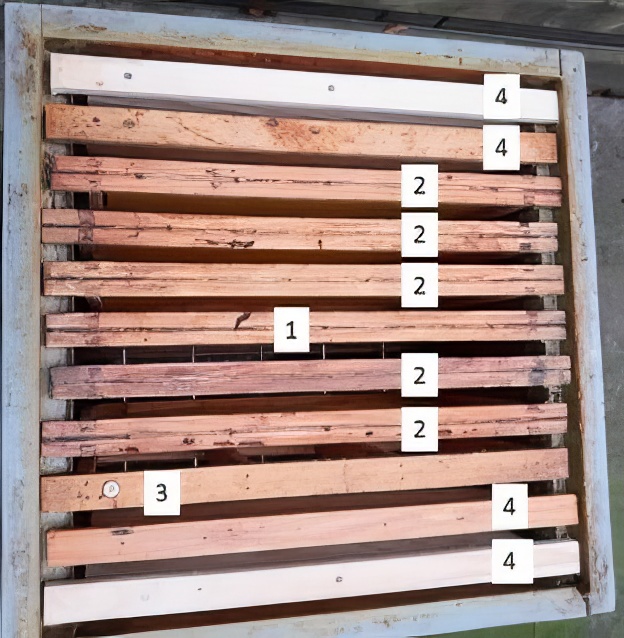
At the beginning of April, I restrict brood rearing in my colonies until the end of July. This means that I leave 4 brood combs, 2 storage combs, 2 pollen combs, and 3 foundation sheets in the bottom super. I install a queen excluder and a second super. In the second super, I leave one building frame (1) in the middle, add five dry frames (2), one drone frame (3), and fill the rest of the space around the edges with four blind frames (4) to narrow the space in the super. I place the queen in the super and put the queen excluder back on. See Figure 5.
Every 10 to 13 days, I check my colonies to cut out the drone comb and thus remove a large number of Varroa mites! These drone combs are actually common simplex frames that I have divided into three parts. When cutting out the drone comb, I follow the diagram in Figure 6.
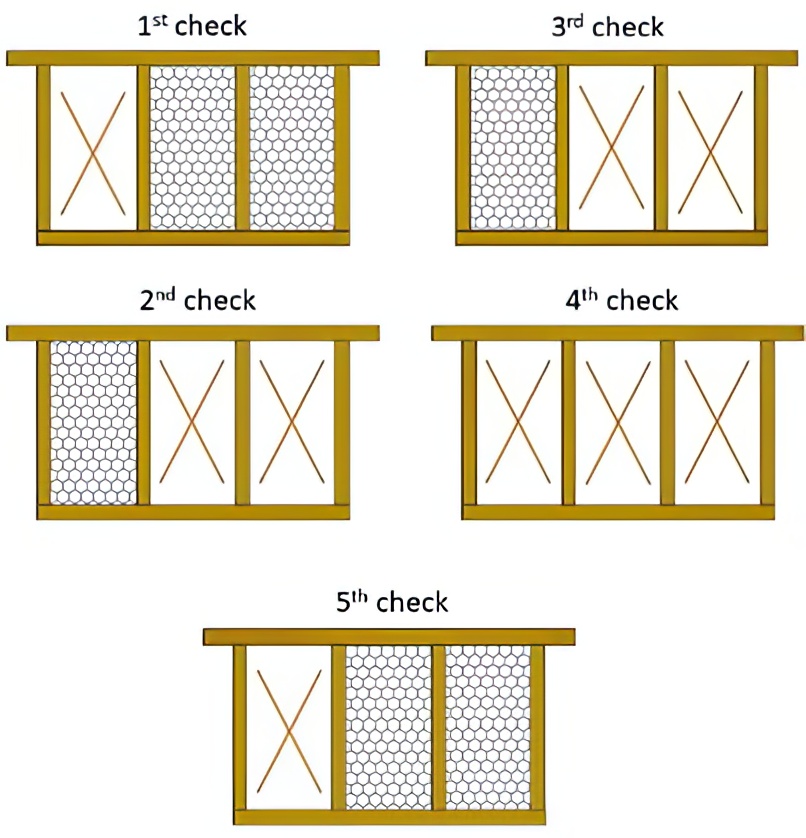
The intention is a kind of work therapy. You have to let your bees work on the building frame. If this does not happen, then it is a warning sign and the colony tends to swarm!
Why do I limit brood rearing? It turns out that there will be a greater yield of spring and later summer honey. The second big advantage is that during the breeding restriction period, I have far fewer combs to check. So I save a lot of time.
Vespa Velutina
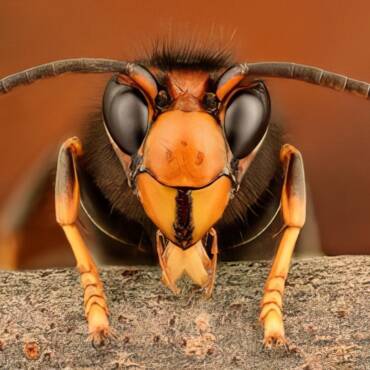
The Asian hornet (Vespa Velutina) has been present in Flanders since May 2017. It arrived in Europe via a bonsai nursery in France in 2004 and has since spread to Spain, Portugal, Italy, Germany, the United Kingdom, the Netherlands, and Belgium.
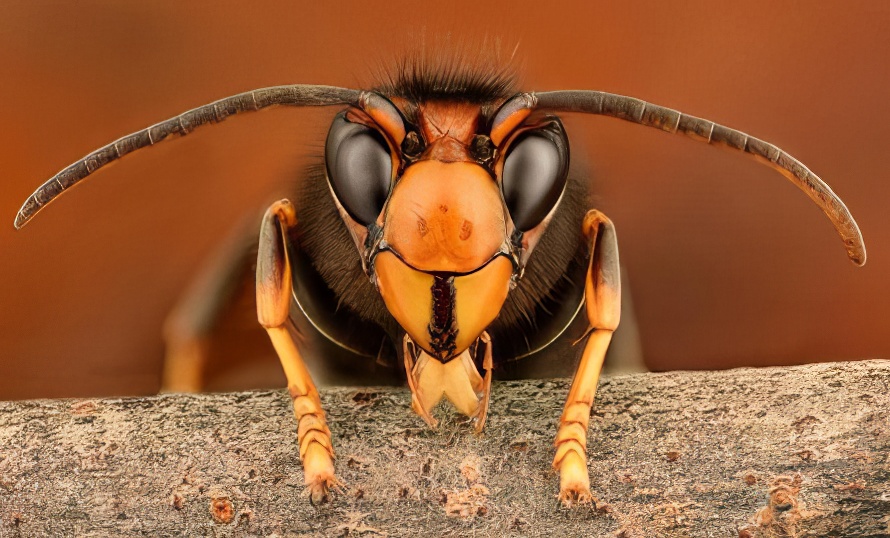
In November 2017, there were 15 sightings in Belgium, 6 of which were in Flanders. Since 2018, the Asian hornet has been observed in all provinces and has spread rapidly.
The Asian hornet is very voracious and poses a serious threat to honey bees and many other insects. A secondary nest consumes 11 kg of insects per year. A nest that is not destroyed produces many new queens for the following year.
The general public does not recognize the Asian hornet, pays no attention to it, and is unaware of its danger. This is gradually changing. Financial support has been promised, and more attention is gradually being paid to eradication. Selective traps are available in some municipalities. In Belgium, nest detection using attached radio transmitters will now be tested.
My experience
Queens wake up from hibernation in March. This is when we need to catch as many queens as possible. Queens start building their primary nest alone and independently. These nests can be found at low heights in bushes, on garden sheds, on eaves, etc. It is best to destroy this nest when there are already a lot of hornets flying around. We try to store the entire litter in a glass jar and then put the closed jar in the freezer for at least half an hour.
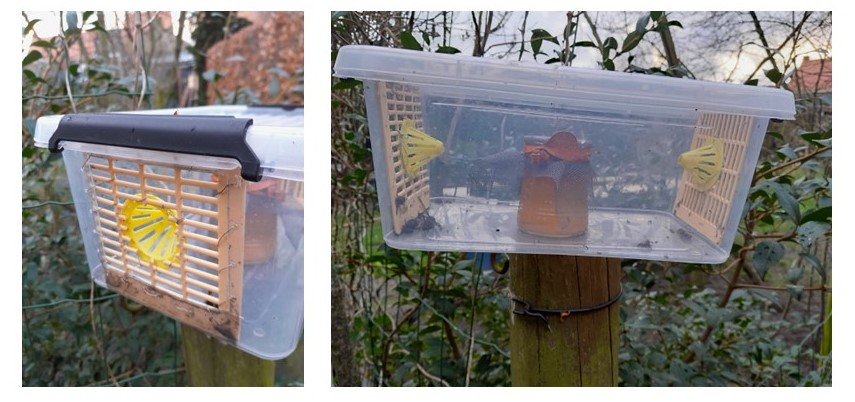
If the primary nest has not been discovered and destroyed, it will eventually become too cramped and the hornets will usually move to a higher location. The higher they find a new location, the stronger the colony becomes. Of course, it is very difficult to find them high up in trees or even on a church tower. In summer, we can try to catch worker hornets using bait and locate the nest in this way.
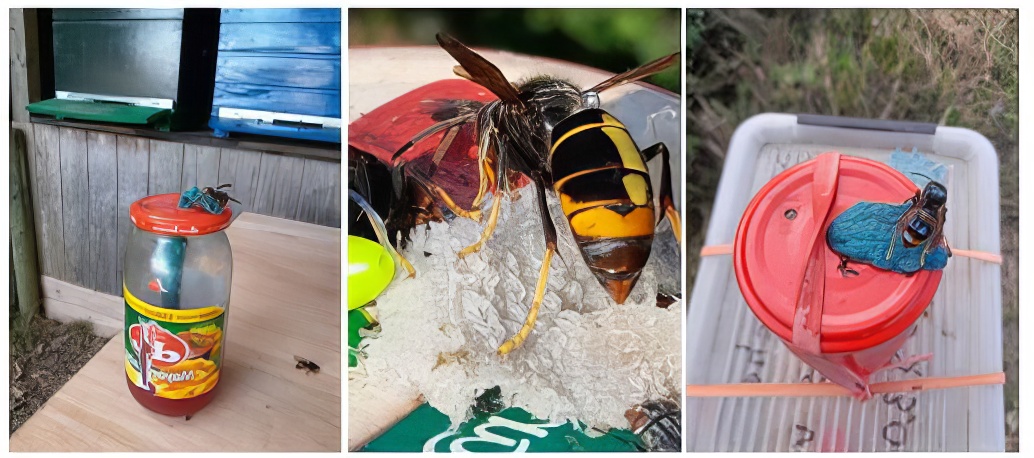
Our jar with bait: We lure the hornets with Trappit, an overly expensive bait (€29.00/l), or a homemade mixture of 1/3 white wine, 1/3 sugar, and 1/3 light beer. It works very well! In picture no. 9, we can see a jar with bait and a wick (a strip of cloth) dipped in liquid and pulled through an 8 mm hole in the lid. There is also a second 4 mm hole for ventilation.
We can locate the nest by first catching the hornets and then marking them (see photo: yellow stripe or blue paint). We mark them to determine how long it takes them to get to the nest and back. It is not entirely clear how long they spend in their nest, but it is estimated to be between 40 and 60 seconds. So, if they return regularly after about 10 minutes, we can assume that they live about 900 to 1,000 meters away.
That was the first step. Now we place the second jar with bait about 200 meters further in the direction of their flight and remove the first jar with bait only after they find the second jar with bait. So we move further and find that the distance is getting shorter and we are getting closer to the nest. Once we find the nest, we need to contact a reputable pest control company in Belgium. For this purpose, we know “Vespa-Watch.” Do not try this yourself, you are risking your life! Hornets can penetrate even a beekeeper’s suit!
Since April, I have managed to catch four queens and about sixty hornets, and later, in September, another 25 young queens. Together with my friend Luc, we also managed to locate the nest and have it destroyed.
More information is available at:
Johan Verstraate, beekeeper, Belgium